TreeMax Tree Service
Tree Pruning in Sacramento: Professional Service for Healthy Trees
TreeMax provides professional tree pruning in Sacramento, which is the same work people also call tree trimming: the selective removal of branches to improve a tree's health, structure, safety, and clearance from roofs and driveways. Light maintenance pruning can be done year-round; heavier work is timed, and for most deciduous trees that means the winter dormant season.
Your estimate is provided by an ISA Certified Arborist; the work is done by our own crews. We're licensed and insured (CA #1040660) and backed by 416 five-star Google reviews. Call (916) 580-7932.
Tree Pruning and Tree Trimming Are the Same Work
Tree trimming and pruning are the same service here. A pruning service visit is selective branch removal for health, structure, safety, and clearance from roofs and driveways. Professional pruning is that work, whichever of the two words you use.
Types of Tree Pruning We Do
Different trees and different goals call for different cuts. During the estimate we'll tell you which of these your trees need, and why.
Crown Cleaning
Removes dead, dying, diseased, and weakly attached branches from the crown. It is the most common pruning job and the starting point for most trees we see. The result is a safer tree with less to drop on roofs, cars, and walkways. Heavy deadwood is covered on our deadwood removal page.
Crown Thinning
Crown thinning removes outer-edge branches selectively and never guts the tree. Interior and middle growth stays in place so light and air can move through the crown without stripping it.
Crown Raising
Removes lower branches to give clearance over sidewalks, driveways, and sight lines, taken up gradually so the trunk keeps enough lower foliage to stay strong. The Sacramento Tree Foundation says to elevate branches 8 feet above sidewalks and 14 feet above streets.
Crown Reduction
Reduces a tree's height or spread by cutting branches back to lateral branches when a tree has outgrown its space. Our work is done properly and to ISA standards.
Structural Pruning (Young and Mature Trees)
Structural pruning shapes a tree's framework so it grows strong: one dominant leader, well-spaced limbs, and fewer weak unions. On young trees it corrects codominant stems early, while the cuts are small. On mature trees it reduces the load on weak unions. Cabling and bracing is a related option when a weak union is worth supporting.
Directional and Clearance Pruning
Steers growth away from roofs, solar panels, and structures by removing branches back to limbs that grow in a better direction. See roof & building clearance for work over your home.
How We Prune: To ISA Standards
A good pruning job is mostly about what you leave on the tree. The work is done by our own crews, and the work is done to ISA standards. A few rules guide every cut:
- Cuts are made at the branch collar, so the tree can seal the wound.
- No lion-tailing, which strips the inside of limbs and leaves foliage only at the tips.
- We remove only what's needed, never a fixed percentage just to fill a day.
- We stay within the Sacramento Tree Foundation's young-tree guidance: no more than 25% of the live canopy in any one year.
Why topping harms trees: cutting main stems back to stubs forces a burst of weak, fast-growing shoots that attach poorly. The large wounds invite decay, and the tree ends up more likely to fail than before it was cut. If a tree is too big for its space, crown reduction is the right tool. Our work is done properly and to ISA standards.
When to Schedule Tree Pruning in Sacramento
Only light maintenance pruning happens year-round. That means small deadwood, suckers, and water sprouts. Heavier pruning is timed. For most deciduous trees, the default window is the dormant season, roughly December through February, when the structure is easier to see. The species calendar is in our guide to the best time to prune trees in Sacramento.
Valley oaks and other native oaks
UC Master Gardeners say mature oaks usually need only dead, weak, diseased, or dangerous wood removed, and that light pruning can be done any time of year. Heavier pruning depends on the oak.
- Light maintenance (small deadwood, suckers, and water sprouts) can be done any time.
- Heavier pruning of deciduous oaks, including valley oak, belongs in the winter dormant season.
- Heavier pruning of evergreen interior live oak belongs in July or August.
- Deadwood can come out any time.
In the City of Sacramento, native oaks at 12-inch DSH or larger are Private Protected Trees, so pruning them needs a city permit (see below). Read our valley oak care guide and the best time to prune trees in Sacramento.
Deciduous shade trees
Shade trees that drop their leaves are usually pruned while dormant, in late winter. With the leaves off, the branch structure is visible, and the tree is ready to seal cuts when spring growth starts.
After storms
Broken, hanging, or cracked limbs are a safety issue, not a calendar question, and they are not light maintenance. They should come out as soon as they are safe to reach. See emergency tree service, hazardous limb removal, and what to do after storm damage.
How Often Should Trees Be Pruned?
No set number of years fits every tree. How often to prune depends on the species, age, condition, and goals, and it should be decided while looking at that tree. For young shade trees, the Sacramento Tree Foundation says to check structure every winter, starting the first winter after planting. That check is for shade trees.
If a tree looks like it may need to come out rather than be pruned, read how to tell if a tree needs to be removed.
Do You Need a Permit to Prune a Tree in Sacramento?
In the City of Sacramento, pruning a City Tree or a Private Protected Tree needs a permit; most other private trees don't. According to the City of Sacramento tree permits page, Private Protected Trees include:
- Native trees (valley, interior, coast, and blue oaks, California sycamore, and buckeye) at 12-inch DSH or larger.
- Any tree at 32-inch DSH or larger on a lot with a single-family or duplex home.
- Any tree at 24-inch DSH or larger on undeveloped land or other property types, such as commercial or apartments.
City Trees are trees in a City park, on City property, or in the public right-of-way, including street and park-strip trees. The city's application lists “Prune” as a regulated activity and charges a $50 fee to cover arborist costs. The invoice is mailed after processing. Applications are generally processed within 10 business days, and the city notes that this time frame can vary. The $50 is the city's fee.
Unincorporated Sacramento County (Carmichael, Fair Oaks, Orangevale, Antelope) and other cities have their own rules. See our guides for the City of Sacramento, Sacramento County, and Citrus Heights.
What to Expect: Our Pruning Process
- 1
Call (916) 580-7932 or request an estimate online. We typically respond the same day.
- 2
Free on-site estimate. Your estimate is provided by an ISA Certified Arborist; the work is done by our own crews.
- 3
Free written estimate, so you know the price before any work starts.
- 4
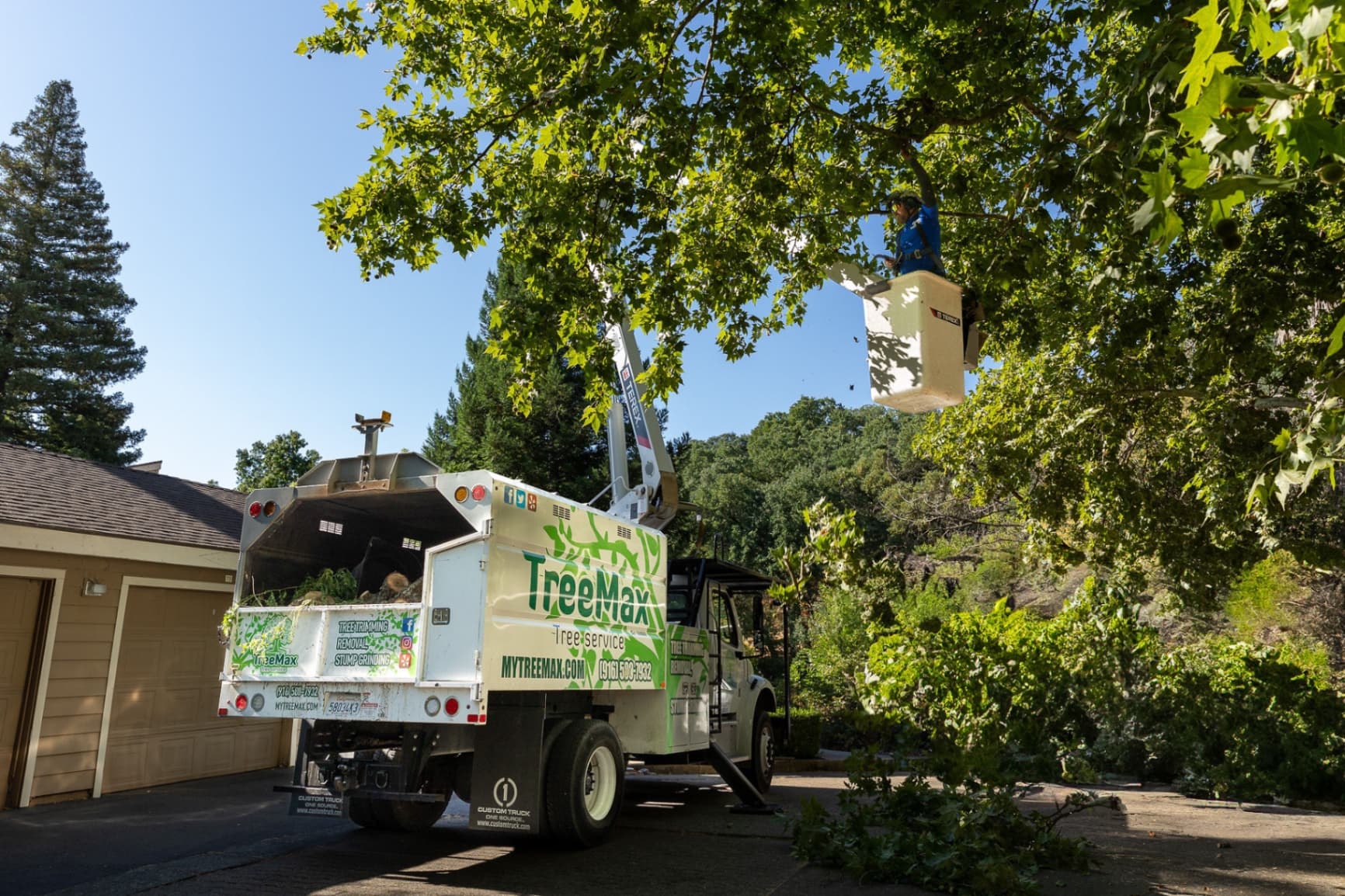
Pruning with aerial lifts, climbing, and rigging as the tree and site require.
- 5
Full cleanup: branches chipped, the area raked and blown, and logs left on request.
- 6
Payment on completion. We accept cash, credit cards, Zelle, and cryptocurrency.
How Much Does Tree Pruning Cost in Sacramento?
Price depends on the size of the tree, how many trees, access, how close the work is to structures, and cleanup. Two numbers cover most jobs:
- Small tree added to a larger job: about $200–$400.
- Standalone or small-scope visit: $650 minimum, often around $850.
That's why you may see both figures on our site. A small tree costs much less when the crew and equipment are already there for other work. A visit just for one small job still carries the cost of bringing the crew and equipment out. Estimates are free. For more detail, see our tree trimming cost guide. This service is also on our tree trimming page, which is the same work.
Why Sacramento Homeowners Hire TreeMax for Pruning
- ✓Your estimate is provided by an ISA Certified Arborist; the work is done by our own crews.
- ✓416 five-star Google reviews
- ✓CA Contractor License #1040660
- ✓General liability and workers' compensation insurance
- ✓Family-owned, founded 2017 by Max Echols
- ✓Free written estimates and full cleanup
Read what customers say on our reviews page, or learn more about TreeMax.
Tree Pruning Across the Sacramento Area
We're based at 8421 Auburn Blvd, Suite 258, in Citrus Heights, and we prune trees in these communities. Within the City of Sacramento, that includes Midtown and South Sacramento. For the city overview, see our tree service in Sacramento.
Tree Pruning FAQ
Are tree pruning and tree trimming the same thing?
Yes. Tree pruning and tree trimming are the same work: selective branch removal for health, structure, safety, and clearance from roofs and driveways. People use both words for that service.
When is the best time to prune trees in Sacramento?
Light maintenance pruning can be done year-round. Heavier work is timed, and for most deciduous trees that means the winter dormant season. Species-by-species timing is in our best time to prune trees in Sacramento guide.
Can you prune oak trees in summer?
Light maintenance, such as small deadwood, suckers, and water sprouts, can be done any time. Heavier pruning of deciduous oaks, including valley oak, belongs in winter. Heavier pruning of evergreen interior live oak belongs in July or August.
Do I need a permit to prune a tree in Sacramento?
In the City of Sacramento, you need a permit to prune a City Tree or a Private Protected Tree, including native oaks at 12-inch DSH or larger. Most other private trees do not. The city's application fee is $50, and applications are generally processed within 10 business days.
How much of a tree can be pruned at once?
The Sacramento Tree Foundation's guidance is to remove no more than 25% of the live canopy in any one year. We remove only what the tree needs. Crown thinning, when it is needed, takes selected branches at the outer edge and leaves the interior growth in place.
Is tree topping bad?
Topping cuts main stems back to stubs. That causes weak, fast regrowth and decay, and it raises the chance of failure later. When a tree needs to be smaller, crown reduction is the proper approach. Our work is done properly and to ISA standards.
How much does tree pruning cost in Sacramento?
A small tree added to a larger job runs about $200–$400. A standalone or small-scope visit has a $650 minimum and often runs around $850. Estimates are free, and the price depends on size, number of trees, access, and cleanup.
How often should trees be pruned?
No set number of years fits every tree. It depends on the species, age, condition, and goals, and it should be decided while looking at that tree. For young shade trees, the Sacramento Tree Foundation says to check structure every winter, starting the first winter after planting.
More questions? See our general FAQ.
Get a Free Pruning Estimate
Your estimate is provided by an ISA Certified Arborist; the work is done by our own crews.
We typically respond the same day. Office hours are Mon–Fri 8:00 AM–3:30 PM.